HIPAA Terminology Management for Confluence
Your privacy officer says “breach.” Your IT team says “security incident.” Your legal counsel says “impermissible disclosure.” Under HIPAA, each term has a specific legal definition — and using them interchangeably triggers investigation risk. Manage HIPAA terms in Confluence with version control and proof of who approved each one.
Why does HIPAA terminology drift cause audit findings?
Healthcare organizations handle Protected Health Information across departments — clinical, IT, legal, billing, compliance. Every department develops its own vocabulary, and terms that sound interchangeable carry distinct legal weight under HIPAA.
Terms that consistently cause HIPAA compliance failures:
- “Breach” vs “security incident” — a breach of unsecured PHI triggers notification obligations; a security incident may not. Under the Breach Notification Rule (45 CFR §§ 164.400–414): individual notice (§ 164.404) is required for ANY breach of unsecured PHI regardless of size, without unreasonable delay and no later than 60 calendar days after discovery; media notice (§ 164.406) is required only when a breach affects more than 500 residents of a State or jurisdiction; HHS notice (§ 164.408) is due within 60 days of discovery for breaches affecting 500 or more individuals, and reported via annual log within 60 days after the end of the calendar year for breaches affecting fewer than 500.
- “Covered entity” vs “business associate” — different compliance obligations, different BAA requirements. A vendor calling itself a covered entity when it’s actually a business associate misapplies the entire regulatory framework.
- “Minimum necessary” vs “need to know” — minimum necessary is a HIPAA-specific standard for limiting PHI disclosure; “need to know” is a general security concept. Your policies must use the HIPAA term correctly.
- “De-identification” vs “anonymization” — HIPAA defines two specific methods for de-identification (Safe Harbor and Expert Determination). “Anonymization” is not a HIPAA term and implies a different standard.
- “Authorization” vs “consent” — under HIPAA, authorization is a specific document with required elements for uses beyond TPO. Consent is a broader, less regulated concept.
Which HIPAA rules does a glossary need to cover?
HIPAA compliance rests on three primary rules, each with its own terminology requirements:
| Rule | Scope | Key Terminology Requirements |
|---|---|---|
| Privacy Rule | Governs use and disclosure of PHI in any form | Defines permitted uses (TPO), minimum necessary standard, individual rights (access, amendment, accounting of disclosures), and authorization requirements |
| Security Rule | Protects ePHI through administrative, physical, and technical safeguards | Specifies required and addressable implementation specifications for access controls, audit controls, integrity controls, and transmission security |
| Breach Notification Rule | Requires notification when unsecured PHI is compromised | Defines breach vs security incident, unsecured PHI, risk assessment factors, and notification timelines (individuals, HHS, media) |
Each rule introduces terms that must be used precisely and consistently across all organizational documentation. Our compliance guide maps how terminology governance supports each of these requirements.
HIPAA Terminology — Organized by Rule
The HIPAA terminology landscape, organized by rule and topic:
Core Definitions (8)
Privacy Rule (8)
Security Rule (10)
Breach Notification (5)
Enforcement (4)
| Category | Terms | Examples |
|---|---|---|
| Core Definitions | 8 | PHI, ePHI, Covered Entity, Business Associate, BAA |
| Privacy Rule | 8 | Minimum Necessary, TPO, De-Identification, Authorization |
| Security Rule | 10 | Administrative/Physical/Technical Safeguards, Access Control, Encryption |
| Breach Notification | 5 | Breach, Unsecured PHI, Risk Assessment, Notification to HHS |
| Enforcement | 4 | Civil Monetary Penalty, Corrective Action Plan, Willful Neglect |
Free HIPAA Terminology Packet
34 core, privacy, security, breach-notification, and enforcement terms. Submit your email and the packet is delivered to your inbox.
How Teams Use It
- Privacy Officers maintaining consistent HIPAA terminology across Notice of Privacy Practices, BAAs, and internal policies. Every term links back to the approved glossary definition — no more “which version of this policy is current?”
- IT Security teams writing security plans and incident response procedures that must align precisely with HIPAA Security Rule terminology. “Access control” in your technical documentation must match “access control” in your security policies.
- Compliance departments preparing for OCR audits and managing breach risk assessments. The compliance scanner catches when someone writes “data breach” instead of the HIPAA-defined term “breach” — a distinction that determines reporting obligations.
- Healthcare consultants helping covered entities and business associates build HIPAA programs with standardized term sets across client organizations
- Training teams developing workforce HIPAA training materials that use consistent, legally accurate terminology aligned with organizational policies
Frequently Asked Questions
What is HIPAA minimum necessary?
Minimum necessary is a HIPAA Privacy Rule standard (45 CFR § 164.502(b)) requiring covered entities and business associates to limit uses, disclosures, and requests of protected health information to the least amount needed to accomplish the intended purpose. It does not apply to disclosures to the individual, disclosures for treatment, or disclosures authorized by the patient.
What is the difference between a breach and a security incident under HIPAA?
A security incident (45 CFR § 164.304) is any attempted or successful unauthorized access, use, disclosure, modification, or destruction of information — or interference with system operations. A breach (45 CFR § 164.402) is specifically the acquisition, access, use, or disclosure of unsecured PHI in a manner not permitted by the Privacy Rule that compromises its security or privacy. Every breach starts as a security incident, but not every security incident is a breach.
Who is a business associate under HIPAA?
A business associate (45 CFR § 160.103) is any person or entity that performs functions or activities on behalf of a covered entity involving the use or disclosure of PHI — including claims processing, data analysis, utilization review, billing, and certain cloud/SaaS providers. Business associates must sign a Business Associate Agreement (BAA) and are directly liable under the HIPAA Rules.
When must breaches be reported to HHS under HIPAA?
The HIPAA Breach Notification Rule (45 CFR §§ 164.400–414) imposes three separate obligations:
- Individual notice (§ 164.404) — required for ANY breach of unsecured PHI regardless of size, without unreasonable delay and no later than 60 calendar days after discovery.
- Media notice (§ 164.406) — required only when a breach affects more than 500 residents of a State or jurisdiction, within the same 60-day window.
- HHS notice (§ 164.408) — for breaches affecting 500 or more individuals, without unreasonable delay and no later than 60 calendar days after discovery; for breaches affecting fewer than 500 individuals, logged and reported to HHS annually, no later than 60 days after the end of the calendar year.
Reference: HHS Breach Notification Rule overview — https://www.hhs.gov/hipaa/for-professionals/breach-notification/index.html.
What this app does — and does not do
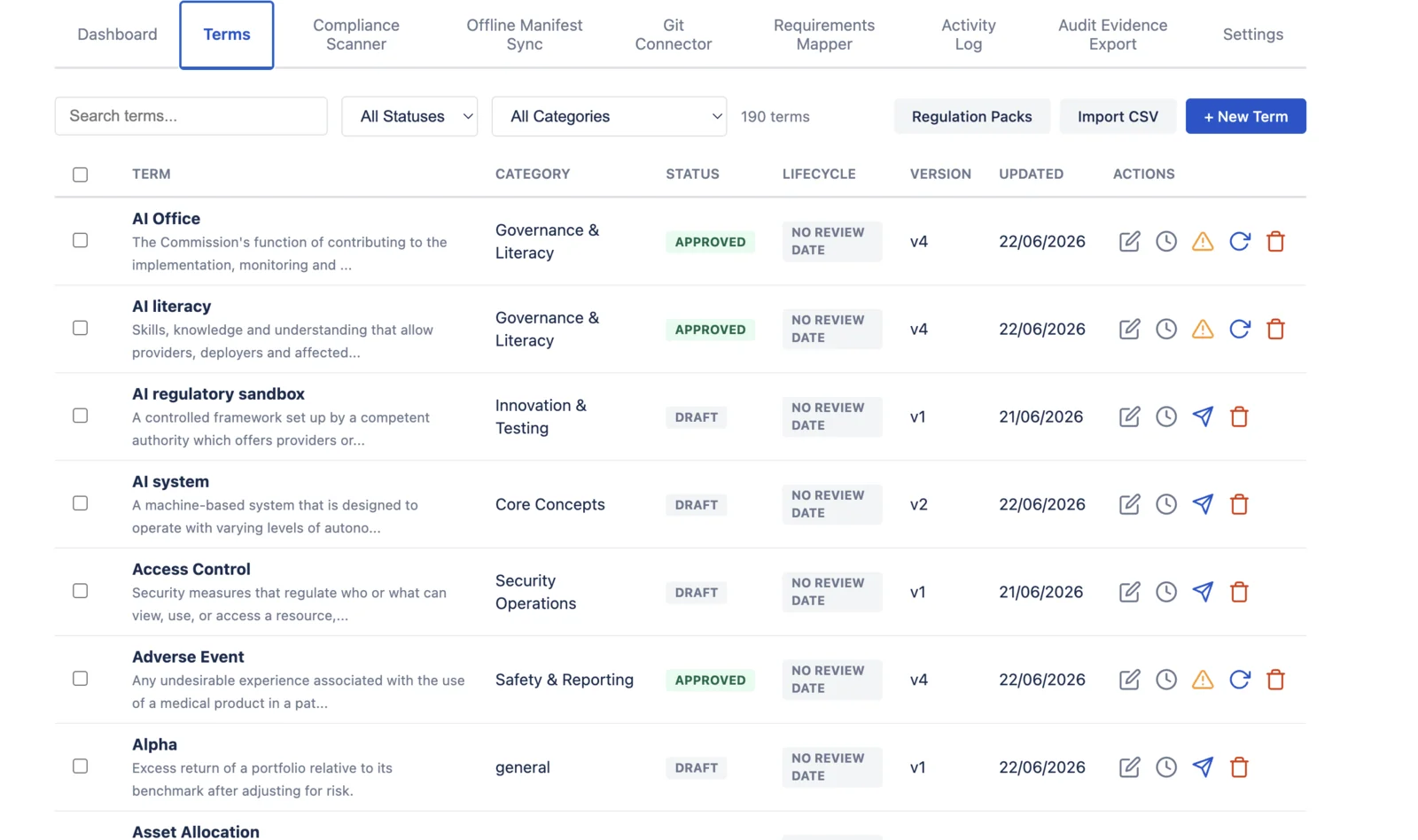
- Does — centralize HIPAA terminology in Confluence with four-eyes approval, version history, scheduled reviews, and scan-for-drift across pages. Produces an audit-ready terminology evidence package.
- Does not — replace your Business Associate Agreements (BAAs), Notice of Privacy Practices, security risk analysis under 45 CFR § 164.308(a)(1)(ii)(A), or breach risk assessments. Terminology governance supports these artifacts; it does not substitute for them.
- Does not — store, process, or transmit Protected Health Information (PHI). The app stores term names, definitions, approvers, and metadata only, via Atlassian Forge managed storage. It is a terminology governance tool, not a PHI repository.
- Does not — constitute legal advice. Definitions are drafting aids; final language for regulated documentation must be reviewed by your privacy/legal counsel.
HIPAA-Ready Terminology in Minutes
Build your HIPAA glossary in Confluence using the terminology packet as a starting structure. Approve your definitions. Scan your docs. Hand the evidence package to your compliance officer. Review our transparent app limitations for full details on what we do and don’t cover.
Evaluate in Confluence Get Free Packet