Watch: Forward vs backward traceability: which one does your auditor want?
The embedded player uses YouTube’s privacy-enhanced domain. You can also watch the video on YouTube.
Transcript
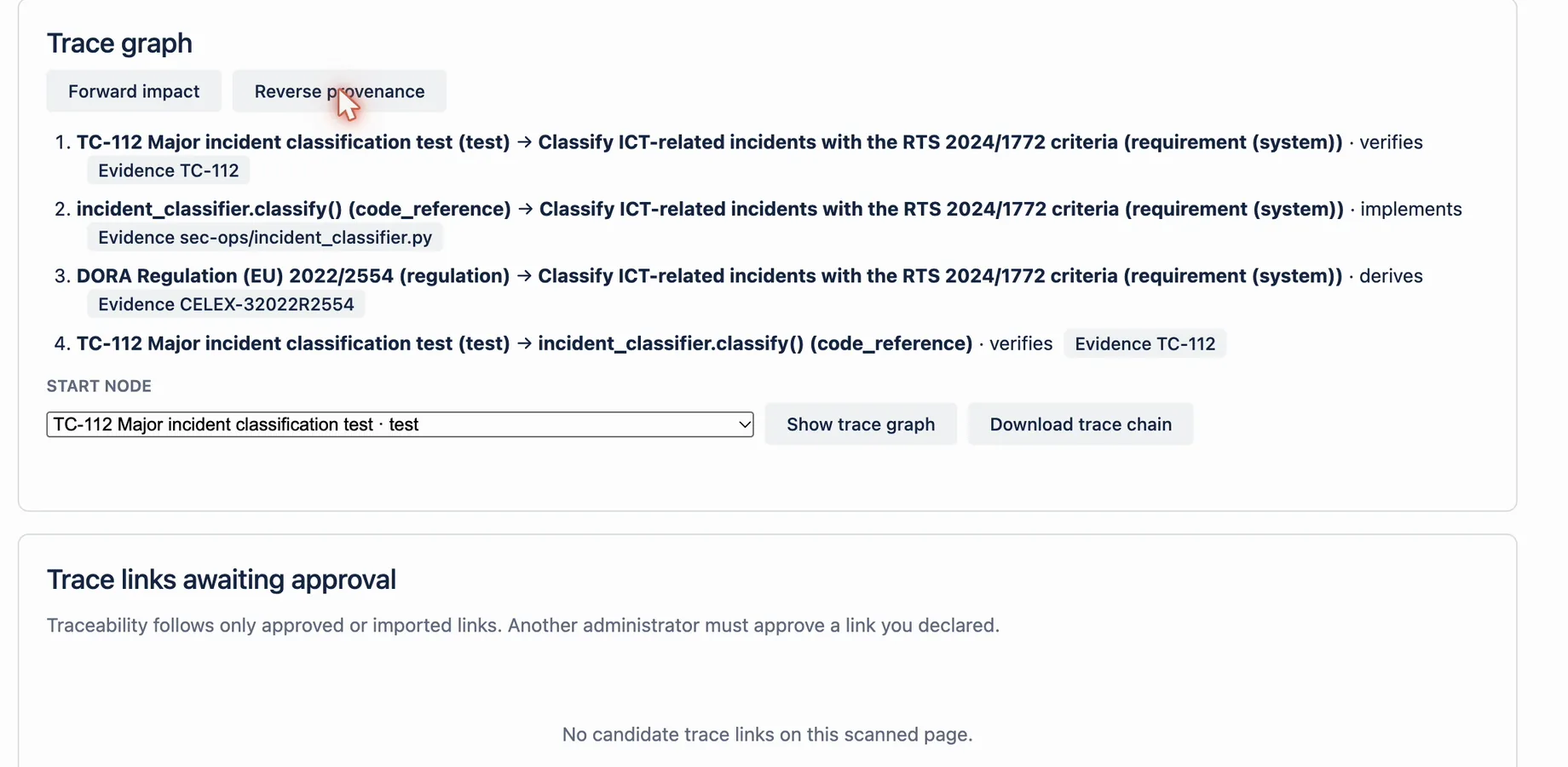
Forward or backward traceability: which one does your auditor want? Forward impact starts from a regulation and shows what implements and verifies it. Reverse provenance starts from a test or a line of code, and walks back to the regulation behind it.
At a glance
| Input | Action | Output | Limit |
|---|---|---|---|
| Declared trace node | Choose it in Start node and select Show trace graph | Graph loaded from that node | The picker lists declared nodes that are approved or awaiting approval |
| Loaded graph | Select Reverse provenance | Ordered upstream hops | Default view: 5 hops and 200 links |
| Approved or imported link | Traverse toward its source | Typed requirement or decision path | Candidate and rejected links are excluded |
| Hop with an evidence ID | Select the Evidence button on the hop | Record selected for slice and handoff downloads | Other hops show "Evidence unavailable" with a reason |
| Unapproved start or bounded result | Report it | Entry under Coverage blockers | The app does not repair external sources |
How it works
- Open Terminology Baseline and find Enterprise evidence workspace.
- In Trace graph, choose the implementation node in Start node.
- Select Show trace graph.
- Select Reverse provenance.
- Follow the typed links toward the root reason.
- Check Coverage blockers and every "Evidence unavailable" hop.
- Select Download trace chain to keep the path.
Example
An investigator starts from a declared code reference node. Reverse provenance follows an approved implements link to an element-level requirement. Derives links lead to a system requirement and an authorizes link to a business decision. A hop with no retained evidence shows "Evidence unavailable" instead of disappearing.
What this does not mean
Reverse traceability reports declared and approved links only. Code and tests are declared nodes with a reference; no code revision is captured. The app does not infer undocumented reasons or approve suggested links. A complete-looking path is only as reliable as its approvals and coverage.
Related questions
Next step
Use reverse provenance when leadership needs the recorded reason behind an implementation.
View on Atlassian Marketplace